
Called to Care
Adam Kinsaul’s heart for healthcare, teaching and mission work
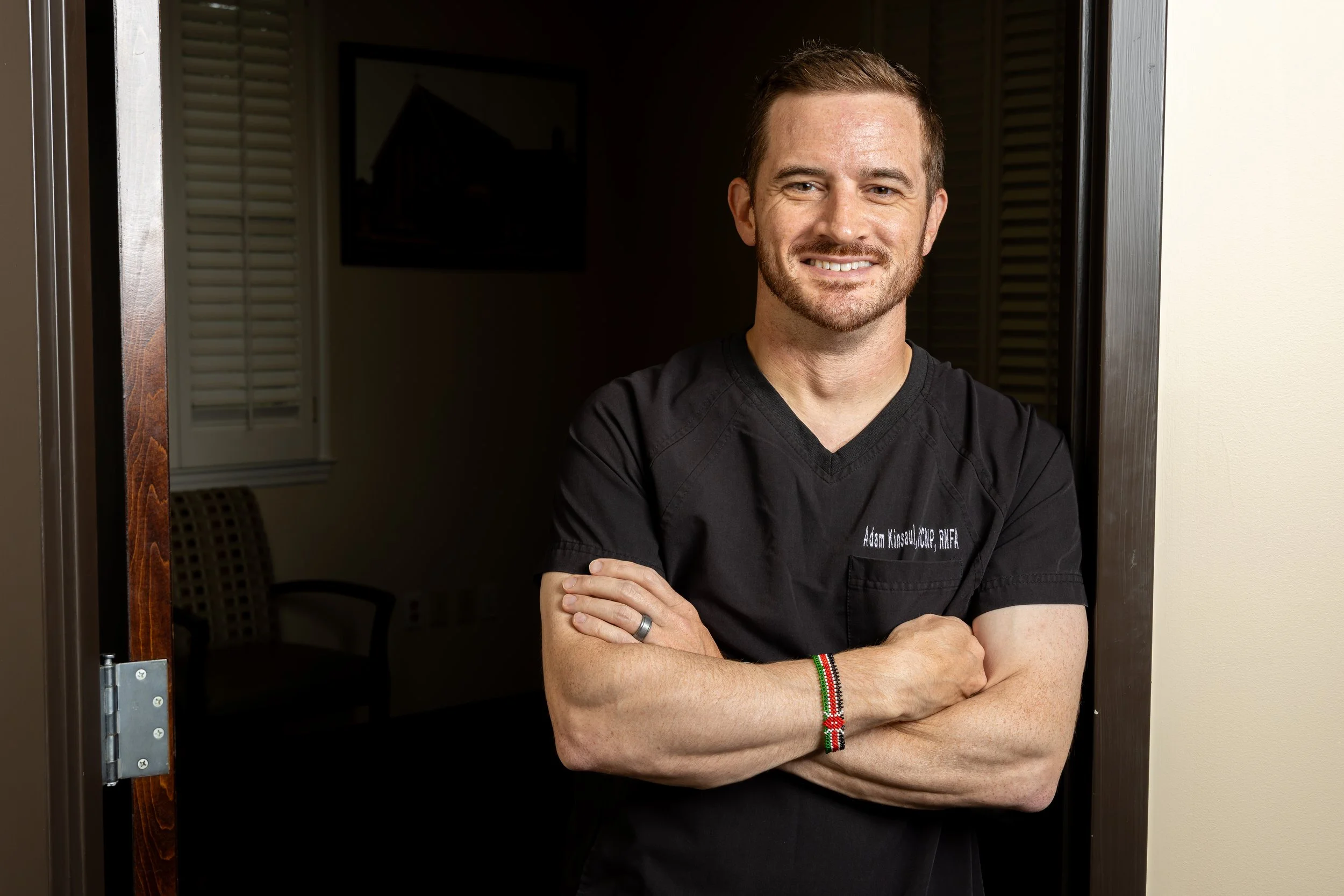
Words by Jenny Lynn Davis | Image by Justin Hunter
Adam Kinsaul has never viewed healthcare as just being about charts and checklists. From his earliest days in nursing school to his current work in both clinical practice and academia, he’s always been drawn to the human side of the work.
“I always knew I wanted to go into healthcare,” he says. “At one point, I considered surgery—something in orthopedics or cardiovascular—but I realized I didn’t want to spend the next 15 years in training. I wanted to get to work helping people.”
Adam began his studies at the University of Alabama but transferred to Bevill State Community College to fast-track his way into the nursing field. While working as a student nurse at St. Vincent’s in Birmingham, he remembers passing the old hospital sign each day: Where Caring Is Your Calling.
“That stuck with me,” he says. “It helped me see nursing as more than a profession, but as a mission.”
After earning his RN degree in 2006, Adam returned to school to pursue his bachelor’s degree through the University of North Alabama, followed by a master’s in nursing at the University of Alabama at Birmingham (UAB) while working at UAB Hospital. By 2010, he had become a certified nurse practitioner, ready to serve, teach, and grow in his role.
Not long after, a job opened at Southern Orthopedics in Jasper. It wasn’t what he had envisioned for himself, but it ended up being a perfect fit.
“I got connected to the opportunity through a series of divine nudges,” he says. “Orthopedics wasn’t on my radar, but it gave me a chance to blend fast-paced clinical work with long-term patient relationships. Fifteen years later, I’m still grateful for that season.”
Adam eventually took a brief detour back into cardiology at UAB but quickly realized he missed the personal connections he had formed in his previous role. That realization helped pave the way to what would become his next great passion: teaching.
His transition into a full-time faculty position at UAB’s School of Nursing in 2024 felt like a natural next step. He’d been adjunct faculty there for more than a decade, and the time was right to dive in fully.
“Watching students grow and succeed is one of the most rewarding parts of my job,” he says. “Helping them understand how to care holistically—body, mind, and soul—is just as important as teaching the technical skills.”
These days, Adam splits his time between the classroom and the clinic. On Tuesdays and Fridays, he still sees patients at Southern Orthopedics. The rest of the week is devoted to lectures, course development and mentorship.
His clinic days are varied, ranging from acute injuries and fractures to chronic osteoarthritis management and osteoporosis care. But even on the busiest days, Adam approaches each case with the mindset that healthcare is ministry.
“I’ve learned to pray first, act second,” he says. “Whether it’s diagnosing a fracture or prescribing antibiotics, I try to center myself and remember that ultimately, God is the one who heals. I’m just a vessel.”
That faith-first mindset didn’t always come naturally. Like many in the medical field, Adam initially struggled with the tension between science and spirituality.
“There were times I’d pray with patients, but in the back of my mind I’d be thinking about statistics, survival rates, progression of disease,” he says. “It felt like two separate worlds.”
Everything began to shift when he read the book Helping Without Hurting by Steve Corbett and Brian Fikkert, which reframed his understanding of service and healing.
“It reminded me that we can use our training, our knowledge, our medicine—but we also have to trust that God is working through us,” he says.
That belief fuels not only his clinical work and teaching but also his involvement in global medical missions, particularly through Sweetwater Outreach, a nonprofit based in Walker and Jefferson County that focuses on providing clean, safe water access, promoting health, and enhancing hygiene in East Africa.
Adam grew up knowing the organization’s founder, John Blevins, whose background in wastewater management and civil engineering laid the groundwork for the mission. After earning his NP certification, Adam joined a medical mission trip to Honduras that sparked his desire to do more internationally. By 2015, he had joined Sweetwater’s efforts in Tanzania and Kenya.
His first medical mission trip with Sweetwater was humbling. He arrived with only basic supplies and a willingness to help. One of his first collaborators was a Kenyan nurse named Mary Gorelty, who was treating patients from a repurposed shipping container. On their first day together, they saw 80 patients.
“I was overwhelmed,” he says. “But also deeply moved. It reminded me how powerful simple acts of care can be.”
Since then, he’s returned annually, sometimes leading teams of 10 to 15 volunteers. Over the course of a three-day clinic, they’ve treated anywhere from 700 to 1,400 patients. The work includes primary care, orthopedics, water filter demonstrations, health and hygiene education, and spiritual support.
One story that stays with him is of a woman in Kisii County who arrived with a severe chest wound. With limited tools, Kinsaul treated her over the course of three days and prayed with her before she left. He had no way of knowing what would happen. A year later, she returned completely healed.
“It was one of those moments that reminds you that God really does use what we bring,” he says.
Though Sweetwater is only one part of Adam’s work, the lessons he learns overseas deeply inform his approach back home. He’s become a strong advocate for rural health and access to care in Alabama, where provider shortages and structural barriers make it difficult for many to receive timely treatment.
Now serving as president of the Nurse Practitioner Alliance of Alabama, Adam is focused on improving access through policy change, scholarships, and mentorship. He also challenges his students to think beyond textbooks and techniques.
“We talk about social determinants of health, community needs, and how to advocate for underserved populations,” he says. “Healthcare doesn’t happen in a vacuum. It happens in real life.”
For Adam, that real life is full. He and his wife Emily are raising four children in Jasper, balancing school drop-offs, hikes, and summer adventures. But no matter how packed his schedule gets, his purpose remains stays the same.
“Whether I’m in a classroom, a clinic, or a clinic halfway across the world,” he says, “my job is to show up, be present, and trust that what I am doing matters.” 78