
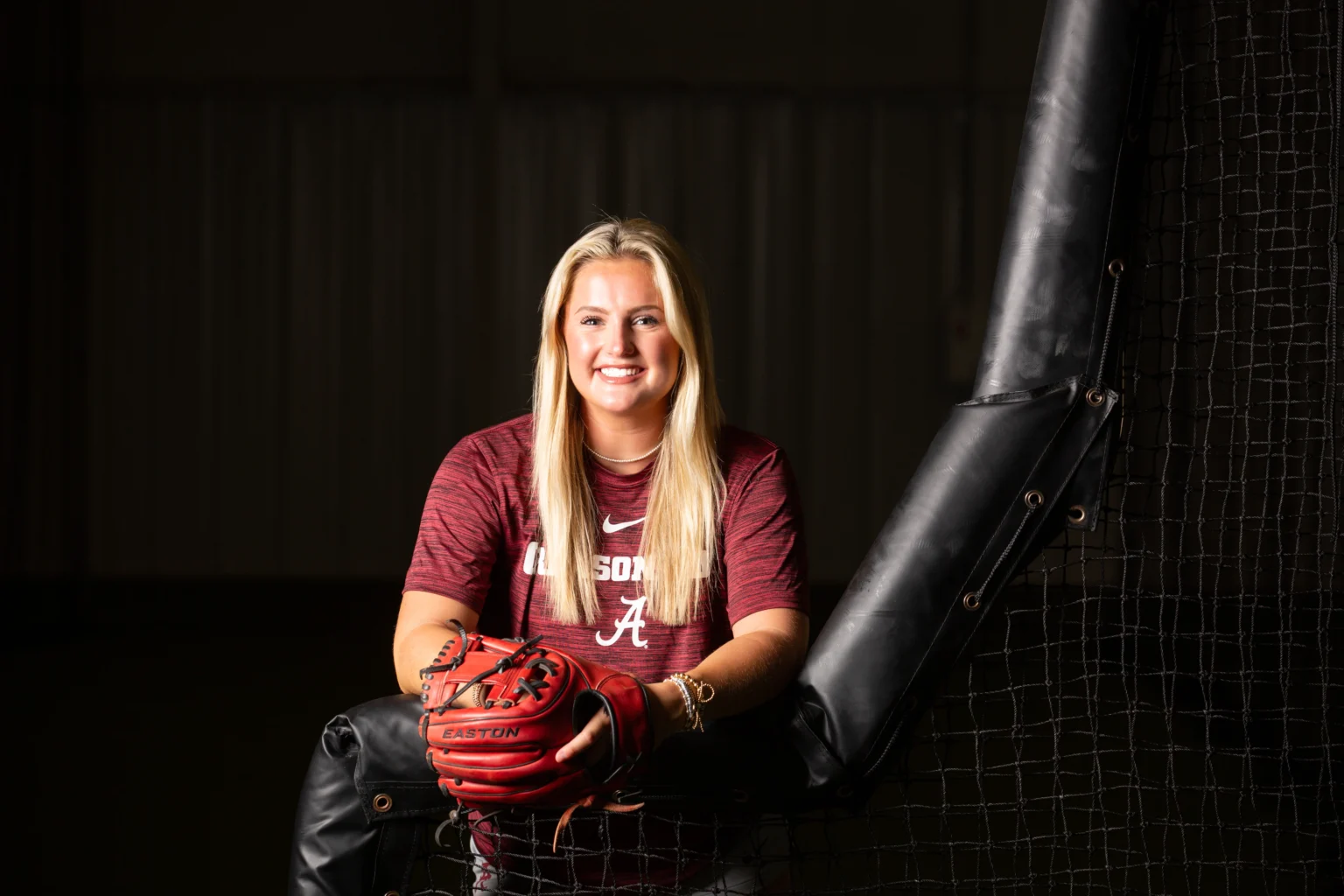




Ambrey Taylor’s freshman season at Alabama began with a home run and became a story of resilience, belonging, and carrying her small-town roots with her.
Words by Jenny Lynn Davis | Images by Al Blanton
Ambrey Taylor did not ease into college softball.
In her first career at-bat for The University of Alabama, the Curry High School graduate stepped in as a pinch hitter against Villanova and sent the ball over the fence.
As she rounded the bases, the nerves gave way to relief, then joy. Waiting at home plate was a group of teammates who celebrated as though the moment belonged to all of them.
“My team was so happy for me,” Ambrey recalls. “Seeing how much they support me and love me was really cool and rewarding.”
It was the beginning most freshmen only imagine. But as unforgettable as that swing was, Ambrey’s first season with the Crimson Tide was never going to be defined by one home run. The months that followed became more layered: a lesson in patience, pressure, humility, and in learning to contribute before the role she wanted was fully hers.
Ambrey arrived in Tuscaloosa hoping to become a starter. That was the standard she had set for herself, and it was not an unreasonable one for a player who had spent years standing out. At Curry, she had been a state champion, a state championship MVP, and one of the most recognizable players on the field.
College, however, required a different kind of growth.

She began the season largely as a reserve and pinch-hitter, an adjustment for someone who was used to being in the lineup and being known. Instead of letting that discourage her, Ambrey had to learn to support the players in front of her while preparing for moments that might come her way.
“I wasn’t used to not playing,” she says. “Once I figured out how to be a good teammate and support everyone, when I finally got my opportunity, it was so much easier.”
Those opportunities kept coming. Ambrey appeared in 53 games and made 39 starts, steadily turning limited chances into a larger role. She arrived early for extra work, sought additional repetitions, and asked coaches what she needed to improve.
The physical demands of SEC softball were expected. The mental demands proved harder. Her first-at-bat home run showed her she could succeed on the college stage, but it also created an impossible standard. Ambrey had to learn that every chance could not end with the same storybook result.
“The mental part of college ball is the hardest thing about it,” she says. “I had a lot of growing up to do.”
That growth began to show as the season progressed. Ambrey points to Alabama’s series against then-No. 1 Texas as the moment she began to feel she truly belonged. It was only her second SEC start, but when the public address announcer called her name and the crowd erupted, she allowed herself to take it in.

By then, Ambrey had already shown a gift for consequential moments. In the series finale at Missouri, pitching coach Lance McMahon challenged her to become the “crowd silencer” before a sold-out road crowd. Assistant coach Kayla Braud helped Ambrey form an approach for one specific pitch.
Ambrey missed it twice. The third time, she got it.
Her go-ahead three-run home run helped change the game and offered another glimpse of the competitor she had always believed herself to be.
“I like pressure because I like coming through,” she says. “I tell myself I’m built for these moments.”
But Ambrey’s season was not only built on the moments when she came through. It was also shaped by the ones when she had to respond after she did not.
After a difficult series against South Carolina, Ambrey lost her starting position. She admits the decision was deserved, but that did not make it easy. With the SEC Tournament approaching, she had only a few days to reset mentally and decide how she would respond.

She answered with one of her strongest stretches of the season, hitting .500 in the tournament and going 5-for-10 with two home runs, a double, and three RBIs. Her performance earned her a spot on the SEC All-Tournament Team.
“That is one moment I’m really proud of myself for,” she says. “I kind of grew up right there and said, ‘OK, you can do this.’”
Alabama’s season continued to the Women’s College World Series, where the Crimson Tide finished third. For Ambrey, it meant playing in front of roughly 12,000 people and standing on a stage that once would have seemed almost impossible to the little girl who first followed her older sister into recreational softball.
Before Alabama’s first game in Oklahoma City, Ambrey looked around, took a deep breath and decided she could not keep looking if she wanted to stay calm.
“Baby Ambrey would be crying right now,” she laughs.
That younger version of Ambrey began playing softball at age 5. By 8, she was playing travel ball. By 10, she was competing nationally. Even then, the work mattered to her.

When Ambrey was 11, her father realized just how much she wanted it. He was preparing to leave for a fishing trip early one morning when she arrived at the family’s hitting barn on a four-wheeler at 4 a.m. She knew he would be gone all day, and she wanted to hit before he left.
Her father traveled with her through years of softball, while her mother managed life at home with Ambrey’s three siblings. Ambrey says her family sacrificed more than she can repay.
That support system never felt far away during her freshman season, though. At one Alabama game, she looked toward the outfield and saw Curry supporters holding signs that read, “We love Ambrey.” For a moment, the distance between Jasper and Tuscaloosa seemed to disappear.
“This is my community. These are my people, and they support me,” she says. “Now I get to play for the state while still representing and supporting them.”
Ambrey wants that connection to work both ways. She attends youth games, speaks with young players, and offers camps and lessons. She wants girls from communities like hers to understand that a small-school background does not place the biggest stages out of reach.
“I was a little girl with a dream, playing for a tiny school that didn’t have all the resources other schools had,” she says. “I know firsthand that girls from small towns can do it, and I want to show that to others.”

Her freshman year also included growth beyond softball. A business major, Ambrey made the dean’s list both semesters and excelled in her math classes. She is interested in someday owning a business and says she hopes to continue teaching and encouraging young players for years to come.
Within the Alabama program, she is also learning a different kind of leadership. At Curry, others naturally looked to her. At Alabama, Ambrey has embraced what it means to be a servant leader by following upperclassmen, supporting teammates, and preparing to become someone that younger players can trust.
The program’s emphasis on character was part of what drew her to Alabama. Ambrey says head coach Patrick Murphy and his staff teach players how to grow as people, not just athletes. When her college career ends, she hopes to be remembered not only for home runs or honors, but as a joyful teammate, a dependable leader, and someone whose faith shaped how she treated others.
From that hitting barn in Curry before sunrise to the lights of the Women’s College World Series, Ambrey’s path has changed dramatically. Her purpose has not.
She is still playing for the community that raised her. She is still learning how to lead. And somewhere, the next little girl from a small town may be watching, beginning to believe she belongs on the big stage, too. 78